
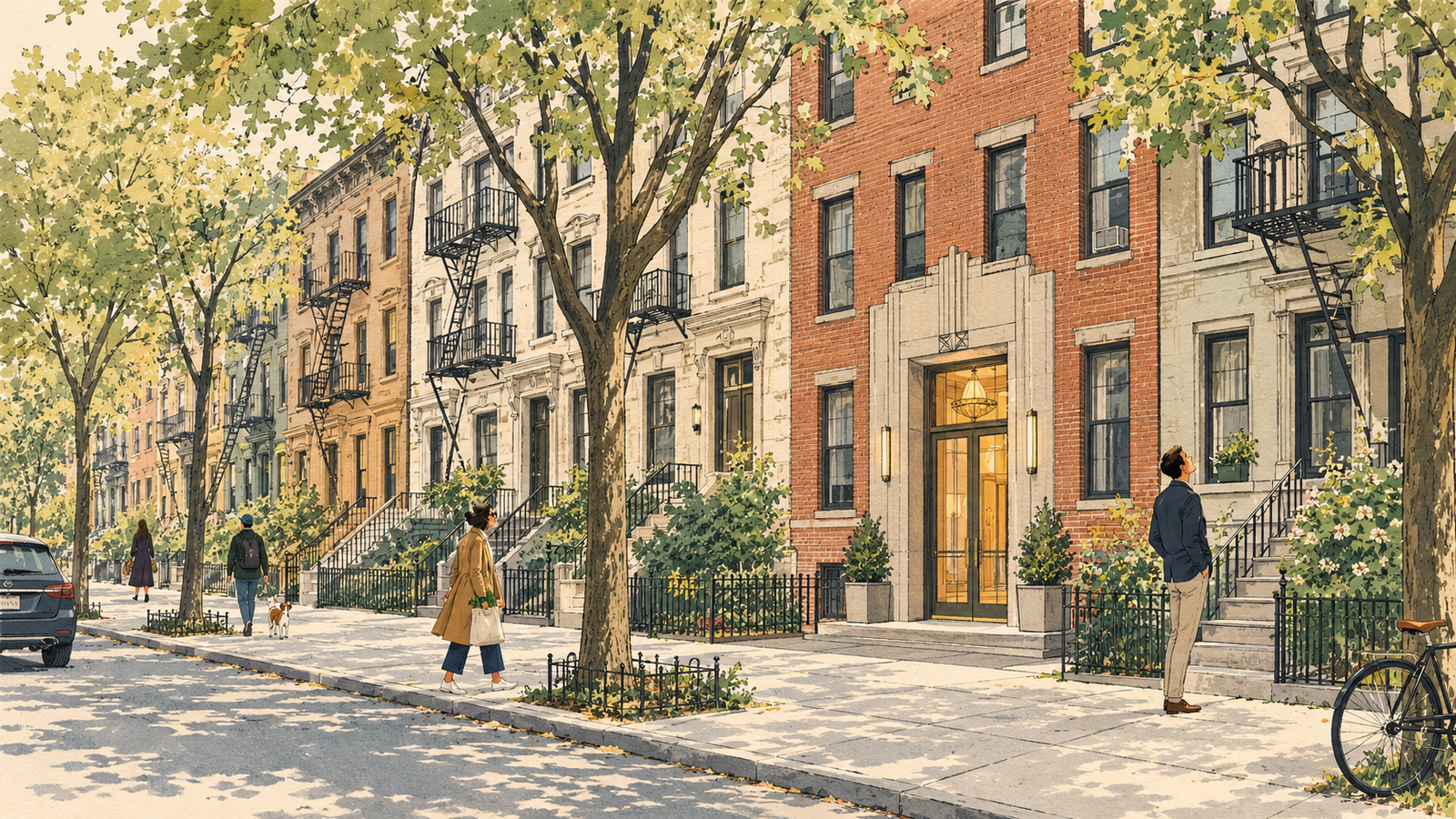
Brooklyn’s market is large and uneven. Prices depend on the block, the building type, and whether the unit is a co-op or a condo, so one citywide number tells you very little. This guide covers the main neighborhoods by price point, how the co-op application works, how to tell a renovated apartment from a staged one, and why Ditmas Park is worth a close look for buyers working under $600,000.
Brooklyn Neighborhoods by Price Point
Brooklyn Heights, Cobble Hill, and Park Slope generally sit at the top of the market. Carroll Gardens, Fort Greene, Clinton Hill, and Prospect Heights occupy the middle. Flatbush, Ditmas Park, Crown Heights, and Bed-Stuy usually offer more space per dollar, and Sunset Park, Bay Ridge, Bensonhurst, and Sheepshead Bay are often the most affordable of the established neighborhoods. Within any of these, the block matters as much as the neighborhood.
I’d treat any single 2026 price figure with caution, including the ones below. The data I could find comes largely from one brokerage’s market pages, and the numbers on those pages conflict. One page puts Ditmas Park’s median sale price at about $976,000. Other comparison pages from the same site show $630,000 and $571,000 for the broader area. The co-op median is listed at $976,000 on one page and $557,500 on another. Those differences likely reflect different boundaries, time windows, and unit types, so the right move is to pull current closed sales for the specific block and building type you want, from StreetEasy, the broker’s comps, or public records.
Ditmas Park: Where the Under-$600,000 Search Gets Interesting
Ditmas Park is one of the few Brooklyn neighborhoods where a buyer working under $600,000 still sees a meaningful range of co-op and apartment options. A single-listing snapshot from the same market data shows a one-bedroom co-op on Avenue H at $339,000 with 769 square feet in a 1937 pre-war building, which gives a sense of the entry level.
The more relevant question for many buyers is whether they can find a fully renovated, full-service co-op with the features that matter day to day. One example is 570 Westminster Road, Unit B19, which is listed at $579,000. According to the listing, the one-bedroom with a home office has an in-unit washer, a gas range, a rebuilt bathroom, a 24-hour doorman, an elevator, and a private garden behind the building. Those claims should be verified in person, but they show what a buyer at this price point can target: laundry inside the unit, a dedicated office, and full-service building staff in a pre-war co-op.
Two cautions apply. First, in-unit laundry and office space are worth confirming unit by unit, since older buildings often lack them and buyers notice when they’re present. Second, a price under $600,000 does not guarantee a good co-op. The building’s finances, reserves, and pending assessments matter just as much as the apartment.
The Co-op Application Process
A co-op purchase is a purchase of shares in a corporation, plus a proprietary lease. The board must approve you, which makes the process different from buying a condo.
Your contract will typically be subject to board approval, so have an attorney review it before you sign. Then you’ll submit an application package that usually includes tax returns, bank and brokerage statements, employment verification, a personal financial statement, references, and a letter of intent. Many buildings also run a credit check and a background check. Expect an application fee, which can range from a few hundred to a few thousand dollars and is sometimes nonrefundable.
The board interview is the step most buyers find hardest. Boards are evaluating whether you’ll be a financially stable shareholder and a good neighbor. At closing, you may face a flip tax, a transfer fee set by the building and often calculated as a percentage of the sale price, and sometimes a capital contribution.
Plan for a down payment of 20 to 30 percent, and possibly more. Boards also look at your monthly debt relative to income and at your post-closing reserves. Financing rules vary, and some buildings cap the loan-to-value ratio or restrict loan types, so ask the managing agent for the exact requirements before you make an offer.
Before offering, request the house rules or offering plan, recent board minutes (these often reveal pending work and disputes), the financial statements and reserve study, the sublet and pied-à-terre policies, and the capital improvement plan.
Move-In-Ready Versus Cosmetically Staged
Staging can make a tired apartment look new for the length of a showing. Virtual staging can do the same in photos. Your job is to look past the presentation.
Start with permits. Search DOB NOW for permits covering electrical, plumbing, and structural work, since unpermitted work can become your problem after closing. Ask when the electrical panel and wiring were last updated, and whether the plumbing risers and supply lines are original. Run every faucet, flush every toilet, and check under sinks for staining.
Look closely at ceilings and walls near windows, bathrooms, and top-floor units. Fresh paint over water stains is one of the most common signs of a problem being hidden. Other red flags include mismatched flooring or uneven thresholds, which can signal settling or water intrusion, heavy air fresheners during a showing, furniture blocking outlets or closet doors, and a seller who won’t share renovation invoices or permits.
Visit at least twice, at different times of day. Bring a flashlight and an outlet tester, and have an inspector who understands co-ops evaluate the unit before you commit. If the listing uses virtual staging, as some do, ask the agent to confirm which rooms and features are actual rather than digitally added.
Before You Make an Offer
Search each building’s address for HPD, DOB, and ECB violations, open permits, and any court cases. Unresolved violations can become a liability for the corporation and, through it, for you. Confirm the monthly maintenance and what it covers, and ask how much of it is tax-deductible. Ask about special assessments, both pending and recently passed, and confirm the flip tax and any capital contribution. Make sure your attorney has reviewed the contract and the building’s financials.
Working with an Agent
Brooklyn has many agents who specialize in particular neighborhoods, and a Corcoran-affiliated agent with block-level knowledge can be a useful guide, especially in Ditmas Park, where building types and co-op policies vary from one block to the next. The listing for 570 Westminster Road is represented by Shabir Ahmad, a licensed agent with Corcoran who says he lives a few blocks from the building and has more than ten years of experience. A good agent should welcome detailed questions, provide comparable sales, and support your inspection and document requests.
Disclosure: this guide was prepared with a Corcoran-affiliated listing in mind and includes references to one specific property. Listing details come from the listing page and are not independently verified. Market figures come from third-party data pages that conflict with each other, so confirm current prices with a licensed professional. All information is deemed reliable but not guaranteed. Square footage is approximate.
Leave a Reply